


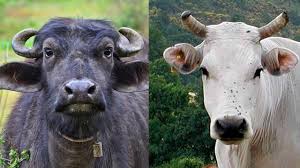
Details
The scheme “Maintenance of Pregnant Desi/Indigenous Cow/Buffalo Ration Scheme for BPL families belonging to Scheduled Caste (SC) category” had been launched by the Department of Animal Husbandry, Government of Himachal Pradesh with the aim to provides a 50% subsidy on a balanced ration for pregnant cows or buffalo during the last trimester of pregnancy. Under this scheme, balanced ration @ 3kg/day/cow or buffalo for maximum of two animals for three months during the last trimester of pregnancy at 50% subsidy of BPL families belonging to the Scheduled Caste category may be provided.
Objectives:
Increase in milk production thereby providing more economic gains to the farmers.
To reduce the inter-calving period which will ultimately result in more calves and higher milk production.
To improve the health of pregnant cows & buffaloes so that their full milk production potential can be realized after parturition.
To ensure the birth of healthy calves free of diseases and malnutrition so that they grow to become higher-producing animals.
As the incentive is being given to Desi/Indigenous cows and buffaloes, the farmers can be motivated to rear such animals.
Assumptions:
A balanced ration will be provided @ 3kg/day/cow for three months (last trimester of pregnancy).
The cost will be shared by the Government and beneficiary on a 50:50 basis.
The cost of feed will depend upon the tender/approved rates.
Benefits
Ration: 3 kg of balanced ration per day for a maximum of two animals for three months.
Milk production: Milk production increases by 2 liters per day after feeding the ration.
Income: If the farmer sells the milk at 30 rupees per liter during the 300-day lactation period, their income may increase by approximately 18,000 rupees per year.
Eligibility
The beneficiary should be a permanent resident of Himachal Pradesh.
Livestock owners belonging to BPL of Scheduled Caste category families rearing Desi/Indigenous/crossbred cows or buffaloes are eligible under the scheme.
The subsidy will be provided to each BPL of Scheduled Caste category families for a maximum of up to two Desi/Indigenous cows/their crosses or buffaloes.
Application Process
LINK- https://hpahdbt.hp.gov.in/Home/MaintenanceCowBuffaloRationSchemeUnderScsp
Online
Visit the official website of the department of the Animal Husbandry, Government of Himachal Pradesh, which implements the specific scheme.
The applicant may read the complete guidelines of the scheme for “Maintenance of Pregnant Desi/Indigenous Cow/Buffalo Ration Scheme for BPL families belonging to Scheduled Caste category” and if found eligible, may scroll down and click on the checkbox “I agree with the terms & Conditions” and click “Proceed” button.
Once Proceed, online application form open.
Fill the application form, upload the documents such as proof of BPL status, land documents, and bank account details and click Submit.
Submit the application form and documents to the concerned department or authority.
Check the status & Follow up with the concerned department to track the status of the application.
Note:
It is important for farmers to keep a copy of the application form and documents submitted for future reference. Additionally, farmers should ensure that they comply with the guidelines and regulations of the scheme to ensure that they are eligible for the benefits of the scheme.
During the application form, the applicant can enter maximum 2 in the section “No. of Animal” and shall be required to enter the “Kind of Animal” and “Ear Tag Number” of each cow.
Documents Required
Copy of Aadhaar card.
Copy of Bank Passbook.
Number of animals along with their Ear Tag Number.
Copy of BPL certificate.
Copy of Pregnancy certificate.
Copy of Income certificate.
Copy of Residence proof.
Other relevant documents as listed by the department from time to time.
Note: Files size should be less than or equal to 200 KB and must be in pdf or jpg.
Disclaimer
Hamara Neta is an independent, private application developed and maintained by HANSA AI TECHNOLOGIES. This app does NOT represent any government entity and is NOT affiliated with, endorsed by, or connected to any government body. Official government services should be accessed directly through their respective government portals.